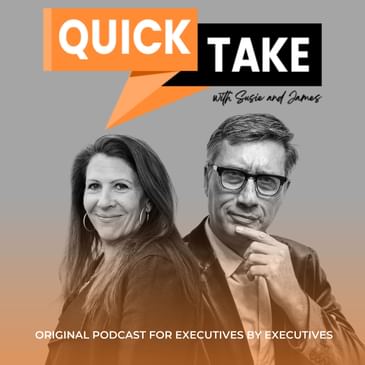
You know that person who always interrupts or hijacks the meeting? Most teams do. And when no one addresses it, everyone loses.
In this episode, we talk about why civility still matters, maybe more than ever. We dig into how small behaviors erode trust, how to spot the patterns early, and what leaders can do in real time to shift the tone. Because culture isn’t just a values slide, it’s every micro-interaction that tells people whether they belong.
Key Takeaways from This Episode:
- Why incivility costs more than just feelings
- How to speak up in the moment without escalating
- What leaders miss when they excuse repeat behavior
Join the Conversation:
What habits are shaping your team’s culture, for better or worse? What are you noticing in meetings, emails, or day-to-day interactions? We’d love to hear how you’re addressing it.
CONNECT WITH SUSIE:
https://www.linkedin.com/in/susietomenchok/
CONNECT WITH JAMES:
https://www.linkedin.com/in/capps/
[00:00:03] Welcome to the Quick Take Podcast, the show where you get targeted advice and coaching for executives by executives. I'm Susie Tomenchok. And I'm James Capps. Give us 15 minutes and we'll give you three secrets to address the complex topic of issues that are challenging executives like you today. Hey, welcome to Quick Take. I'm Susie. I'm Susie. Who are you? The second 30 minutes of this conversation.
[00:00:32] Exactly. Oh, this is a good one because I think a lot of people will be able to relate to this topic of civility in work environments. And what does that mean, James? We've been talking about this for a long time. I just do think that civility in general, it's time in the sun where perhaps we need to revisit some of the concepts around what it takes to work with people.
[00:00:56] I do think this is one of the true victims of working from home is we've kind of lost our skill of working next to humans. And as we've said on this show more than once, you know, we're better together, I think. But the civility element, I think it keeps popping up and I think it's worth talking about. Yeah. I was just talking to a client yesterday that I had been working with her to allow there to be more silence, to really be thoughtful and be aware of what people are saying around her.
[00:01:25] And she goes, oh, now I can't not see the fact that people are annoying from the aspect of interrupting nonverbals, not paying attention, all of those things. In fact, I looked up a U.S. stat that there's almost $2 billion lost in productivity every day by rework and turnover. I believe it. That's looking at the hours and the shift. That's a very loose number.
[00:01:53] But still, that's so interesting to think about it in those terms. Everybody has their own lens of importance. And whether it's working for people that you care about or a passion project or the financial impact, the civility element and treating each other in a certain way, I think it's important. And it impacts your company in numerous ways, whether it's $2 billion in financial negative impact or lost productivity, or it's just through turnover. Either way, you're going to see that. Yeah.
[00:02:21] And it's not just in the moment feeling like somebody's not paying attention or is rude or doesn't allow you to get your thought out. It becomes this, we know that person that does this. And then we come to the meeting with the expectation that I'm just not going to say anything or I'm not going to, because now we have this team muscle that we know what it's like to engage with somebody that is not inclusive.
[00:02:50] Well, I think we tend to excuse that behavior. We just roll our eyes and say, well, that's just Carl. Well, that's the first lesson or first takeaway for all of our leaders is if there's somebody that you are excusing behavior, there is at least a dozen people who are suffering because of that behavior. That is an official James Cass statistic I made up on the spot, but I think that feels pretty good. Those impacts are real. And as leaders, we have a responsibility to address that. And they don't have to be really horrible physical violence.
[00:03:19] They can just be behavior of interruption or dismissiveness or showing up late on a regular basis. Those behaviors are not how we should work in a civil environment. To do it in the moment is really powerful. Like if Carl continues to interrupt or just waits until the conversation stops so that he can redirect it in a different place or make his point, it's really easy to say, hey, Carl, hang on.
[00:03:48] Can we just go back to what Missy said? And hopefully those cues will enlighten Carl. Sure. And if not, if you are seeing this and you have influence in the organization, you need to really need to pull Carl aside and say something to him, even if he doesn't report into you. Yeah. And I think it's so hysterical, too, that you find yourself in this conversation with these people and all of a sudden you're not talking about what you were talking about.
[00:04:15] But we all know the folks who are already preparing their response when you're only two or three breaths into your thought. And they derail the conversation because you went in a different direction than they thought you were going to go. But they've already got their response loaded in the chamber and they can't unfire that bullet. And so you find yourself rabbit holing or going in a different direction than perhaps you thought. And I think as a leader or as a coach or a mentor, it's important for us to highlight that at the moment and say, yeah, I see your point there. But can we go back to the original topic?
[00:04:45] Let's finish this thought. That in time redirection is so important. Yeah. My natural tendency is not to try to jump in and get my opinion in unless I'm really feeling it so strongly. And I remember after leaving Comcast, you know, I'd been there 10 years after I did the exit interview and everything.
[00:05:06] I was talking to our leader and he said, the one thing I really don't like about you is that all those years we'd be in meetings and I knew you had something really good to say and you wouldn't say it. You let everybody else talk. And part of me is like, why did you say something earlier? For 10 years, you did with this one thing that I really hated. That's on you. It's interesting. And so, yes, was it on me? I should have really thought that.
[00:05:34] And to me, in my head, I'm like, I don't want to fight to get my work, my voice in there. But on his side, you really do need to also think about drawing in somebody that is not contributing. How can you get more people to be a part of the conversation? Because those people might be shutting them down. Yeah, and you can spot these things. It's really interesting.
[00:05:57] Once you realize, again, I think you said that you were working with somebody who can't unsee it, you'll find that there's one individual that everybody talks over, that they always cut that person off. Or there's always that one person who cuts everybody off. And it's not like you have to pay attention to everybody and kind of micromanage every single person. These things are so obvious in most cases that you can just nip one or two in the bud and they will absolutely have cascading effects.
[00:06:23] One thing I have found, too, is certain people that I work with, we will interrupt each other constantly. It is a way of building on dialogue and it's kind of an energetic kind of thing. But there are people that I can't do that with. And I have to be thoughtful that they feel that that is intrusive and interrupting. There is a case-by-case basis. There are times when I will interrupt somebody and say my apologies for that. And they will say, no, we're all firing on all cylinders here. It's all right.
[00:06:50] But the truth is, is that not everybody, as you described, has the seniority, the experience, or the confidence to be able to have their voice heard. And that's our job to include them. Or they don't want to just jump in. They don't want to try to fight the fight with everyone else. Because sometimes that energy, and I agree, there are times when like banter and going back and forth really elevates both or the whole room. And I think that's really good.
[00:07:16] But it's also this like energy around doing that, that you either opt in or opt out of. It's not for every conversation. It's not for everybody. But it's an interesting point to identify what you need in that moment. Yeah. Be able to say, hey, one microphone, one screen. Let's all be together in this meeting and be, thank you, chat GPT. Let's be really thoughtful about what we're doing here.
[00:07:44] And let's really bring all voices in so that you can set the ground rules. And then that way, if you know Carl has that tendency, poor Carl. We're sorry for anybody's name that's Carl. I know. My fake names everybody knows are Carl and Rachel. And then I was working at BlackRock. And I had a great guy in the UK working for me named Carl. And I had to come up with a new name. It totally threw me off my game. Well, today it's Carl. Poor Carl. Back to Carl. But love you, Carl. Shout out to Carl. Yes.
[00:08:11] So it's how can you be proactive about setting the ground rules and disrupting those habits? Because maybe Carl, that's just the way that he's learned to participate. Sure. And he may need to learn to show up differently. He may not even realize what he's doing. Yeah. I know that there are environments where that is the currency.
[00:08:32] I always used to laugh that when you went to college and you sat down and ate a meal with people, you could tell who had lots of brothers and sisters because they ate like animals and they had to fight for the food because it was either, you know, you grab two pieces of chicken or you're getting none. And if that's the environment that maybe some of these folks have come from, maybe that just needs to be re-skilled. We talk about the importance of having everybody involved and having multiple voices.
[00:08:58] But I also think that those negative behaviors, they really impact people's general performance. And in the engineering side and the development side, we talk about how when a developer has to change course or redirect or has to choose a different thing to work on, that whipsaw effect, it's just really negative on their performance. And changing their direction midstream or more mid-program really just slows everything down.
[00:09:23] Studies have shown that it takes 30 minutes to recover from a negative interaction of incivility. That's a chunk of time. And so there isn't just the feelings being hurt. There isn't just the $2 billion. There's also that productivity has been measured. And I think it's important that we realize that somebody doesn't necessarily walk away from a meeting and feel great and get back to work, that it takes time for them to recover. Yeah.
[00:09:46] And they might talk to somebody else that was in that meeting and, oh, Carl, you know, he did it again. I was so annoyed that we can never have a conversation that isn't interrupted. Right. So, yeah, I mean, that productivity and mental wholeness. Right, right. Feeling like your voice is heard. There's a lot of contributing factors that can really inhibit the culture in that way.
[00:10:11] And so I guess what we're saying is take a look at what are the habits of the culture of the people, of the individuals, and be an observer of conversations, of meetings, and see what's going on that might not be intentional. It might just be something that people are used to that you might be able to shift.
[00:10:32] Eye-rolling, sighing, sending dismissive emails, interrupting, over-speaking, taking credit for others' work, or arriving late to meetings are all things that do this and impact your team. And turning your camera on. Ugh. And looking at the camera, like really being engaged in everything that you do, that the positive ones are shutting down your computer, moving to the person, like opening up to the person.
[00:10:58] Really be thoughtful about how are you encouraging them instead of shutting them down. Oh, that's huge, too. Yeah, I think there's a completely separate dialogue, probably another 20 minutes on how we address this when you're working remote and how you ensure you create that engagement. And we've talked about giving good video context and giving good video conference and making sure you do that. But I think the same thing here. If you're obviously answering email during a meeting or obviously not paying attention and looking elsewhere, that's still an act of instability. Yeah.
[00:11:26] So if you're listening to this, you're welcome because you won't ever be able to unsee all of this. Totally. Totally true. Go and shift it. Go change it now. Thanks for listening to this week's episode of Quick Take, where we talk about the questions that are on the minds of executives everywhere. Connect with us and share what's on your mind. You can find us on LinkedIn, YouTube, or whatever nerdy place on the internet you find your podcasts. All the links you really need are in the show notes.